Daily Learning Experience · Trades edition · September 26, 2026
ToppingOutRaising the steel skeleton of a city
First light over Atlanta. The red clay is already warm, the crane is already turning, and a column is coming up off the trailer. Before this lesson is over, you'll be the one at the controls.
Ironworker · Heavy Equipment Operator (crane) A raising gang at sunrise, Atlanta
6:12 a.m., Downtown Atlanta, August. Crews start early here to beat the heat, and the red clay under your boots is already warm. High above you, the jib of a tower crane swings through the sunrise. On the ground, a steel column that weighs about as much as a small car is being shackled to the hook. Up on the steel, two connectors wait for it, harnesses on, spud wrenches on their belts. The operator in the cab can't feel the load, only read it: the numbers on the screen, the signals from below, the way it swings. Today you learn both jobs, setting the steel like an ironworker and flying it like an operator.
Before the first pick · The raising gang
Five jobs, one lift
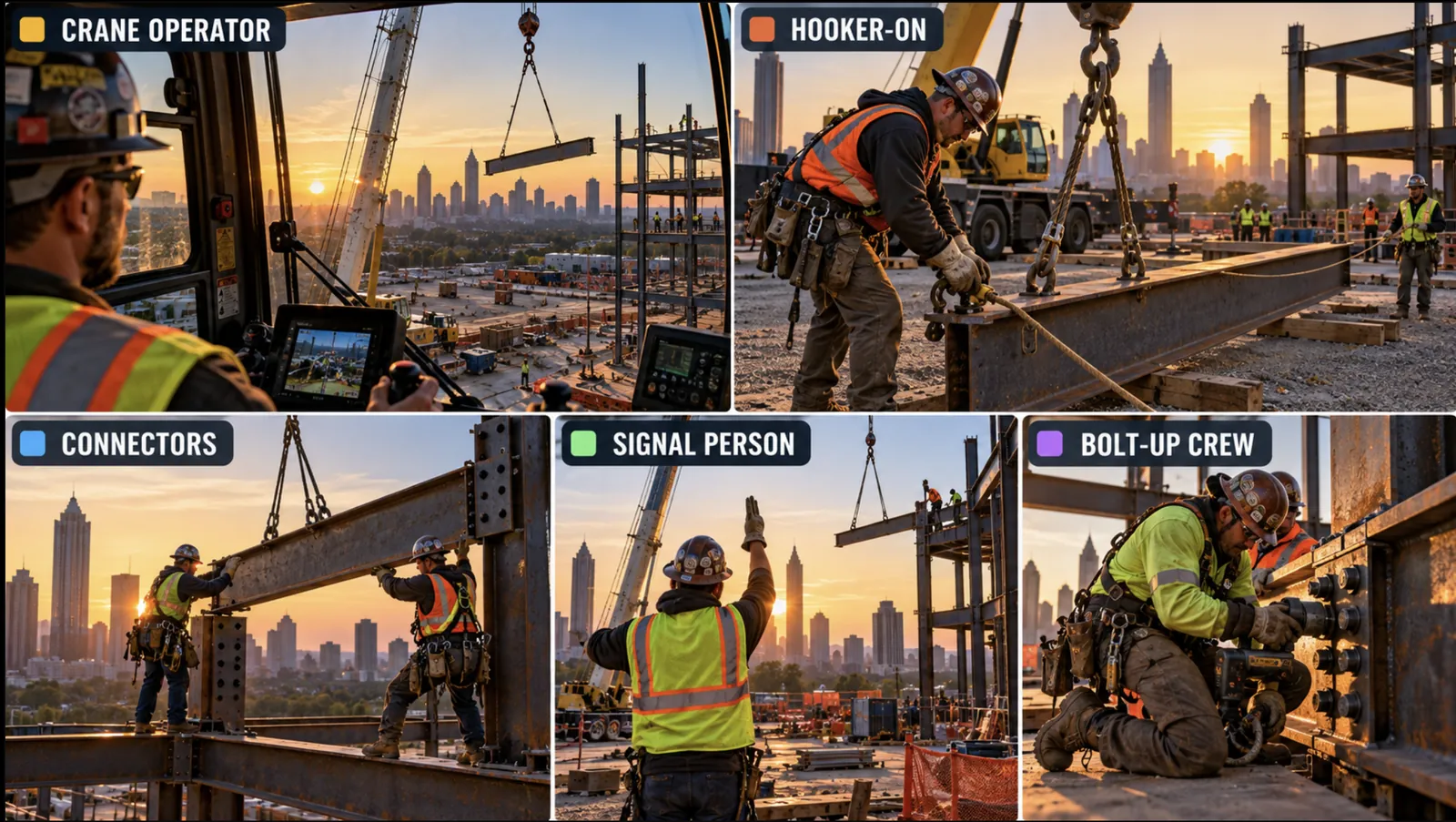
Every piece of steel passes through five sets of hands before it's part of the building. Tap a role to see it in the picture, then follow the same people through the drawing, the crane and the hazard walk below.
Illustration (AI-generated). On the job, connectors working more than 15 ft up wear their fall-protection gear, and above two stories or 30 ft they're tied off or otherwise protected from falls. Many sites require 100% tie-off at any height.
The five roles. Select one to highlight it in the picture.
Chapter I · The drawing and the piece
The skeleton goes up first
Before there are walls, windows or elevators, there is steel. Ironworkers place the columns and beams that form the skeleton of the building, one piece at a time, and every piece comes to them on a crane hook. The crew that does it is called a raising gang, and it works like a relay: nobody touches a piece without knowing who touches it next.
Erection drawing sketch · every piece has a mark, a place and a weight
Inspect the piece in 3D:
Read the piece: weight is written in the name
Steel shapes are named by the way they're made. A W14×90 is a wide-flange shape about 14 inches deep that weighs 90 pounds per foot. That second number is the one the hooker-on cares about, because weight is where every lift plan starts.
W14×90 column, 30 ft long weight = 90 lb/ft × 30 ft = 2,700 lb in tons: 2,700 ÷ 2,000 = 1.35 tons = 1 7⁄20 tons (a U.S. "short" ton is 2,000 lb)
Then add everything else below the hook: slings, shackles, spreader bars. Some load charts already include the hook block and some don't. The notes on the chart tell you which. If it hangs from the hook, it counts.
Piece-weight calculator
lb/ft × length = weight
Shape
Chapter II · The load chart
Why a crane gets weaker as it reaches
A tower crane is a seesaw a hundred and fifty feet in the air. On one side, the concrete counterweights. On the other, whatever hangs from the hook. What tries to tip the crane isn't the weight alone, it's the weight times how far out it hangs. That product is called the load moment.
moment = load × radius 2,700 lb × 80 ft = 216,000 ft·lb the same column at 160 ft = 432,000 ft·lb(twice the reach, twice the moment)
So the load chart in the cab lists a capacity for every radius, and the numbers fall as the trolley runs out along the jib. The chart below belongs to the training crane in this lesson. It isn't real: every real chart is written for one crane, in one configuration, with one jib length. Two rules hold for all of them. Radius is measured from the center of rotation to the center of the load, and if your radius falls between two lines, you read the longer radius, never the friendlier number.
Training load chart
flat-top tower crane · 180 ft jib · lesson use only
Piece on the hook (with rigging)
Percent of chart is the number experienced crews watch. Many contractors treat a lift above a set share of chart capacity (often somewhere around 75%) as a critical lift that needs a written plan and a supervisor's sign-off. Your employer's lift-planning policy sets the exact threshold. Tower cranes must also carry a load moment limiter that stops the crane from moving a load into overload (OSHA 1926.1435). It's a backstop, not a plan. The plan is you, with the chart, before the piece leaves the ground.
Chapter III · Rigging math
The angle is a multiplier
Beams usually go up on a two-leg bridle, two slings from the hook to two pick points at equal distances from the piece's center of gravity. You'd think each leg carries half the beam. It carries at least half, and the flatter the slings, the more they carry, because they're pulling sideways against each other as well as holding the load up.
tension per leg = (W ÷ n) ÷ sin(angle from horizontal) W24×68 × 30 ft = 2,040 lb, two legs at 60°: 1,020 ÷ 0.866 = 1,178 lb each same beam at 45°: 1,020 ÷ 0.707 = 1,443 lb each same beam at 30°: 1,020 ÷ 0.500 = 2,040 lb each (each leg now carries the whole beam)
Sling-angle bench
drag the hook up and down
Sling makers and the rigging standard (ASME B30.9) warn against sling angles below 30° from horizontal, because tension climbs very fast below that. Two more habits come with the math. Hook over the center of gravity: a piece always swings until its center of gravity is right under the hook, so if your pick points aren't balanced, the beam hangs out of level. And tag lines: a rope on the end of the piece lets a worker stop it spinning without standing under it or grabbing the steel. Never wrap a tag line around your hand or your body.
Chapter IV · Rules written by experience
The rules that bring everyone home
These aren't paperwork. Each one exists because someone didn't come home. In the simulator that follows, breaking one of them ends the work order, just as it would stop the job on a real site.
No loads over people
Plan the route so nobody works under a suspended load. In steel erection, the only people allowed under a load are the connectors making the initial connection and the workers hooking or unhooking it.OSHA 1926.753(d) · 1926.1425
Two bolts before you let go
A beam isn't released from the hoist line until each connection has at least two bolts of the specified size and strength, drawn up wrench-tight (or the equivalent the engineer of record specifies).OSHA 1926.756(a)(1)
Four anchor rods per column
Every column is anchored by at least four anchor rods. Anchor rods aren't repaired, replaced or field-modified without the structural engineer of record's approval.OSHA 1926.755(a)(1), (b)
Fall protection on the steel
Ironworkers more than 15 ft above a lower level are protected from falls. Connectors must be protected above two stories or 30 ft, whichever is less, and between 15 and 30 ft they must be given fall protection gear and wear what they need to tie off. Many sites set stricter rules, and the strictest rule on your site is the one you follow.OSHA 1926.760(a)(1), (b)
One voice, standard signals
Use the standard hand signals, and only one signal person at a time. But anyone who sees a safety problem gives the stop signal, and the operator obeys a stop signal no matter who gives it.OSHA 1926.1419 & App. A · ASME B30
Wind: the number is in the manual
Tower cranes carry a wind-speed indicator above the upper structure. The in-service wind limit comes from the manufacturer's manual. A typical value is about 45 mph (20 m/s), and the limit is lower for loads with a big surface area. Out of service, the crane is secured the way the manufacturer says.OSHA 1926.1435 · 1926.1417(n)
Never leave a load hanging
The operator doesn't leave the controls with a load suspended, except under the narrow conditions the standard allows. If you have to stop, land it first.OSHA 1926.1417(e)
Chapter V · Take the controls
Fly the steel
You're in the cab of the training crane, a flat-top tower crane over the same Atlanta site. Five work orders take you from the first column to the topping-out beam: a first column, the level 3 beams, a blind pick flown on hand signals, a deck bundle with a storm coming in, and the signed white beam on top. Watch the load moment indicator (LMI), which warns at 90% of the chart and trips at 100%. Switch between the cab, the signal person's view and an orbit view, and follow the hand-signal card when you can't see the landing. It plays with a keyboard, touch sticks or a game controller.
You're the crane operator from the raising gang: the hooker-on rigs each piece on the laydown, the signal person is your eyes on the blind pick, and the connectors on the steel won't let you release the hook until the bolts are in.
In the simulatorNot started yet. Press “Start the simulator” on the picture above.
The crane, load chart and wind limit here are a training model. A real lift is planned from the manufacturer's manual, the crane's own load chart, the site lift plan and the rules your jurisdiction has adopted.
Chapter VI · Hazard Walk
Walk the site before the steel flies
Before the raising gang sets a piece, somebody walks the site looking for whatever is about to hurt someone. Today that's you. This is a busy steel-erection job: a frame three stories up, a crawler crane, a laydown yard and a street edge with power lines overhead. You'll recognize the gang: a hooker-on, a tagger, connectors on level 3 and a signal person in the operator's view. Six hazards are hiding in plain sight, and some things here are done exactly right.
Walk, look up as well as down, and tap anything that looks wrong. Sort each hazard into one of OSHA's Construction Focus Four, the hazards behind most construction deaths: Falls, Struck-by, Caught-in or -between and Electrocution. Flagging something that's done right costs a few points, because knowing what right looks like is part of the skill.
Hazard Walk · steel erection site
Found0/6
Score0
Stars★★★
Hazard Walk · 0 of 6 found · looking at: —
3:00
Walk
Six hazards. One walk.
You start at the gate on the street side. Check the crane, the laydown yard, the frame and the deck. Take the stair tower up to level 1 to see the deck.
FallsStruck-byCaught-in or -betweenElectrocution
Keyboard (click the scene first): WS or ↑↓ walk · AD step sideways · ←→ turn · RF look up / down · drag to look · click to inspect · Tab moves between points of interest and Enter inspects
A training site, built so every hazard is accurate. Real sites follow the site safety plan, the lift plan and the rules your jurisdiction has adopted, and many are stricter than OSHA's minimums. Check your site's plan and your jurisdiction.
The big idea
Every pick is a math problem with a person underneath it
Weight first. Pounds per foot times feet, plus everything below the hook. Say it in pounds and in tons: 2,700 lb is 1 7⁄20 tons.
Moment is load × radius. Double the reach and you double the moment, so capacity falls as the trolley runs out. Read the chart at the next longer radius and know your percent of chart before you lift.
Angles multiply. Tension per leg = (W ÷ n) ÷ sin θ. At 30° each leg of a two-leg bridle carries the whole load. Below 30°, don't.
Swing is physics you manage. The load is a pendulum. Move smoothly, catch the swing with the trolley, and let the tag lines control rotation.
Safety is part of the skill. No loads over people, two bolts before you let go, four anchor rods per column, fall protection on the steel, one signal person, and anybody's stop. When the wind reaches the limit, land the load and secure the crane.
Your path into this trade
From the ground to the top of the steel
Ironworkers and crane operators (Operating Engineers) learn their trades through registered apprenticeships, most often run by a union and its contractors together through a Joint Apprenticeship Training Committee (JATC). You are hired, you work on real jobs, and you go to class.
01
Paid from day one
Apprentices earn a wage from the first day on the job, usually a percentage of the journeyworker rate that steps up as you gain hours and pass classes. Ask your local JATC for the current scale.
02
Classroom + on the job
Programs typically run several years (often three to four) and pair on-the-job hours with related instruction: rigging, blueprint reading, welding, safety and, for operators, crane and equipment operation.
03
A credential that travels
Finish and you're a journeyworker, and completing a registered apprenticeship is recognized nationally. Crane operators must also hold certification for the type of crane they run (OSHA 1926.1427).
What a day looks like
Before sunrise: safety meeting, lift plan for the day, rigging inspected by a qualified rigger, crane inspected by the operator.
Morning: the raising gang sets columns and beams while it's cool: hooker-on, signal person, connectors and operator working to one rhythm.
Afternoon: bolt-up and welding follow the raising gang. Everybody keeps one eye on the sky, because summer storms build fast in Georgia.
Skills from this lesson you'll use: trade math (weights, fractions of a ton, percentages), reading piece marks and erection drawings, sling-angle rigging math, load charts, standard hand signals and OSHA steel-erection and crane rules.
For current pay and job outlook, see the U.S. Bureau of Labor Statistics Occupational Outlook Handbook pages for ironworkers and for construction equipment operators, and ask a local training center about apprenticeship openings near you.